![St. Mary's Parish [Sanger, CA]](http://images.squarespace-cdn.com/content/v1/5b306db88f51307d4850ce82/1585352374642-I125CF40RV9D4LKCTIQ6/Church+logo.jpg)

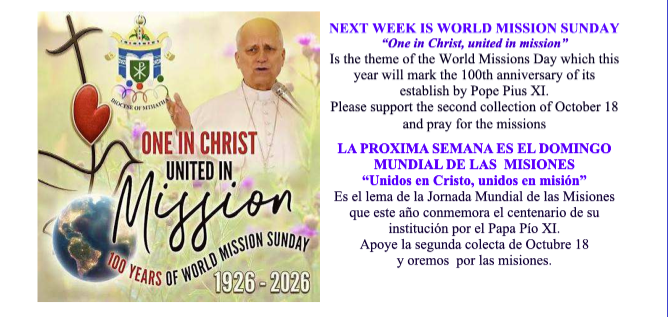
Sunday, October 18th 100 Years of World Mission Sunday
〰️
Domingo 18 de octubre: 100 años del Domingo Mundial de las Misiones
Sunday, October 18th 100 Years of World Mission Sunday 〰️ Domingo 18 de octubre: 100 años del Domingo Mundial de las Misiones
Our Mission
To Worship God in the Eucharist.
To receive and share the good news of Jesus, strengthened by the example of Mary and the Sacraments.
To serve others especially those in need.
Nuestra Misión
Adorar a Dios en la Eucaristía.
Recibir y compartir la buenas nuevas de Jesús, fortalecidos con el ejemplo de María y los Sacramentos.
Servir a los demás especialmente a los necesitados.
Mass Times / Horario De Misas
Mass Daily Readings Lecturas diarias de la misa
100 Year of St. Hannibal
〰️100 Ano De San Anibal
100 Year of St. Hannibal 〰️100 Ano De San Anibal
The Catholic Christian Community of Sanger and Del Rey are both being served by the Rogationists of the Heart of Jesus. Las Comunidades Católicas Cristianas de Sanger y Del Rey son atendidas por los Rogacionistas del Corazón de Jesús.
Who we are
Congregation of the Rogationists of the Heart of Jesus
The charisma of the Rogationists is the intelligence and zeal of the word of Jesus: “The harvest is plentiful but the laborers are few. Pray (Rogate) therefore the Lord of the harvest to send out laborers into his harvest”
(Mt 9:37, Lk 10:2).
The vocation and mission of the Rogationists was born from the human, spiritual, and apostolic experience that Saint Annibale Maria Di Francia (1851-1927), under the guidance of the Holy Spirit, lived among the children and the poor of the Avignone neighborhood of Messina. Recognized by the Church as an apostle of prayer for vocations and a father of orphans and the poor, he was canonized by John Paul II on May 16, 2004.
The mission of the Rogationists is:
- to pray daily to obtain "good workers for the Kingdom of God";
- to spread this spirit of prayer everywhere and promote vocations;
- to be good workers in the Church, committed to works of charity, to the education and sanctification of children and young people, especially the poor and abandoned, to evangelization and human promotion, and to helping the poor.
“The harvest is plentiful, but the laborers are few. Pray therefore (Rogate) the Lord of the harvest to send out laborers into his harvest” (Mt 9:37, Lk 10:2)
From a commentary on the Rogationist passage (Lk 10:2) that Pope Benedict XVI gave on Saturday, February 5, 2011, in his homily for the ordination of five bishops: "The harvest is plentiful, but the laborers are few! Pray therefore the Lord of the harvest to send out laborers into his harvest!" (Lk 10:2). This word from the Gospel of today's Mass touches us particularly closely at this hour. It is the hour of mission: the Lord sends you, dear friends, into his harvest. You must cooperate in that task spoken of by the prophet Isaiah in the first reading: "The Lord has sent me to bring good news to the afflicted, to bind up the brokenhearted" (Is 61:1). This is the work of the harvest in God's field, in the field of human history: to bring men the light of truth, to free them from the poverty of truth, which is the true sadness and poverty of man. Bring them the joyful news that is not just a word, but an event: God himself has come to us. He takes us by the hand, draws us upward, toward himself, and thus the broken heart is healed. We thank the Lord for sending workers into the harvest of world history. We give thanks for sending you, for having said yes, and for this hour when you will once again pronounce your "yes" to being the Lord's workers for humanity.
"The harvest is plentiful"—even today, precisely today. While it may seem that large parts of the modern world, of today's people, have turned their backs on God and consider faith a thing of the past, there is nevertheless a longing for justice, love, and peace to finally be established, for poverty and suffering to be overcome, for humanity to find joy. All this longing is present in today's world, the longing for what is great, for what is good. It is the longing for the Redeemer, for God himself, even where He is denied. At this very hour, work in God's field is particularly urgent, and at this very hour we feel with particular pain the truth of Jesus' words: "The laborers are few." At the same time, the Lord helps us understand that we alone cannot send laborers into his harvest; that it is not a question of management, of our own organizational ability. Only God himself can send laborers into his harvest field. But he wants to send them through the door of our prayer. We can cooperate in the coming of the laborers, but we can do so only by cooperating with God. Thus, this hour of thanksgiving for the fulfillment of a missionary mission is, in a special way, also a hour of prayer: Lord, send laborers into your harvest! Open our hearts to your call! Do not allow our prayer to be in vain!
FOUNDER: ST. HANNIBAL MARIA di FRANCIA
"Pray therefore the Lord of the harvest to send out laborers into his harvest."
Annibale Maria Di Francia was born in Messina on July 5, 1851, to noblewoman Anna Toscano and Francesco, Marquis of Santa Caterina dello Ionio, Papal Vice Consul and Honorary Captain of the Navy. The third of four children, Annibale became an orphan at just fifteen months old following the premature death of his father. This bitter experience instilled in him a special tenderness and love for orphans, which characterized his life and his upbringing.
He developed a great love for the Eucharist, so much so that he received permission, exceptional for those times, to approach Holy Communion daily. At a very young age, before the solemnly exposed Blessed Sacrament, he had what can be defined as "the understanding of the Rogate" : that is, he discovered the need for prayer for vocations, which he later found expressed in the Gospel verse: "The harvest is plentiful but the laborers are few. Pray [Rogate] therefore the Lord of the harvest to send out laborers into his harvest" ( Mt 9:38; Lk 10:2). These words of the Gospel constituted the fundamental intuition to which he dedicated his entire life.
A man of lively intelligence and remarkable literary talent, he responded generously as soon as he heard the Lord's call, adapting these talents to his ministry. After completing his studies, he was ordained a priest on March 16, 1878. A few months earlier, a "providential" encounter with a nearly blind beggar introduced him to the grim social and moral reality of Messina's poorest suburb, the so-called Avignon Houses , and paved the way for that boundless love for the poor and orphans that would become a fundamental characteristic of his life.
With his bishop's consent, he went to live in that "ghetto" and devoted all his energy to the redemption of those unfortunates, who in his eyes appeared, according to the evangelical image, as "sheep without a shepherd." It was an experience marked by misunderstandings, difficulties, and hostility of every kind, which he overcame with great faith, seeing Jesus Christ himself in the humble and marginalized and practicing what he called a "spirit of double charity: evangelization and assistance to the poor."
In 1882, he opened his orphanages, which were called Antonian orphanages because they were placed under the protection of Saint Anthony of Padua. His concern was not only to provide food and work, but above all to provide a complete moral and religious education, offering his patients a true family atmosphere that fostered the formative process of discovering and following God's plan.
With a missionary spirit, he wanted to embrace orphans and the poor throughout the world. But how? The word of Rogate opened this possibility to him. So he wrote: "What are these few orphans who are saved and these few poor who are evangelized compared to the millions who are lost and abandoned like flock without a shepherd? ... I was looking for a way out and I found it broad, immense in those adorable words of our Lord Jesus Christ: Rogate ergo ... Then it seemed to me that I had found the secret of all good works and of the salvation of all souls."
Hannibal understood that the Rogate was not a simple recommendation from the Lord, but an explicit command and an "infallible remedy." This is why his charisma should be considered the guiding principle of a providential foundation in the Church. Another important aspect to note is that he was ahead of his time in considering vocations even among committed lay people: parents, teachers, and even good governors.
To realize his apostolic ideals in the Church and in the world, he founded two new religious families: the Congregation of the Daughters of Divine Zeal in 1887 and the Congregation of the Rogationists ten years later. He required the members of the two institutes, canonically approved on August 6, 1926, to commit themselves to living the Rogate with a fourth vow.
Thus Di Francia wrote in a 1909 petition to Saint Pius X: «From my earliest youth I have dedicated myself to that holy Word of the Gospel: Rogate ergo . In my smallest charitable institutes, an incessant, daily prayer is raised by orphans, the poor, priests, and sacred virgins, in which the Most Sacred Hearts of Jesus and Mary, the Patriarch Saint Joseph and the Holy Apostles are implored to provide the Holy Church abundantly with chosen and holy priests, with evangelical workers for the mystical harvest of souls». To spread the prayer for vocations, he promoted numerous initiatives: he had epistolary and personal contacts with the Supreme Pontiffs of his time; he established the Sacred Alliance for the clergy and the Pious Union of Evangelical Rogation for all the faithful. He founded the periodical with the significant title «Dio e il Prossimo» to involve the faithful in living the same ideals.
"It is the whole Church," he wrote, "that must officially pray for this purpose, since the mission of prayer to obtain good workers is such that it must be of lively interest to every believer, every Christian, who has at heart the good of all souls, but in a particular way to the bishops, the shepherds of the mystical flock, to whom souls are entrusted and who are the living apostles of Jesus Christ . " The annual World Day of Prayer for Vocations , established by Paul VI in 1964, can be considered the Church's response to this intuition.
He had a great love for the priesthood, convinced that only through the work of numerous and holy priests can humanity be saved. He was deeply committed to the spiritual formation of seminarians, whom the Archbishop of Messina entrusted to his care. He often repeated that without solid spiritual formation, without prayer, "all the efforts of bishops and seminary rectors are generally reduced to an artificial culture of priests..." He himself was, first and foremost, a good worker of the Gospel and a priest after the Heart of God. His charity, described as "without calculation and without limits," was also particularly evident toward priests in difficulty and cloistered nuns.
Even during his earthly existence he was accompanied by a clear and genuine reputation for sanctity, widespread at all levels, so much so that when he passed away in Messina on June 1, 1927, comforted by the presence of the Most Holy Mary, whom he had loved so much during his earthly existence, people said: "Let us go and see the sleeping saint."
The funeral was a true apotheosis, which the newspapers of the time duly recorded with articles and photographs. The authorities were quick to grant permission to bury him in the Temple of the Evangelical Rogation , which he himself had commissioned and which is dedicated precisely to the "divine command": "Pray the Lord of the harvest to send laborers into his harvest."
Plenary Indulgence Mission St. Claire at Three Rivers CA October 14
Indulgencia plenaria en la Misión St. Claire, Three Rivers, California, el 14 de octubre.
Plenary Indulgence Mission St. Claire at Three Rivers CA October 14 Indulgencia plenaria en la Misión St. Claire, Three Rivers, California, el 14 de octubre.



Scan the QR Code to Register.
Come and learn about St. Hannibal.

CLERGY & STAFF
St. Mary's has a caring and hardworking staff, which includes our Rogationist Priest.
We have many experienced individuals and volunteers who work hard to meet your needs.

WORSHIP WITH US
We offer many masses, services, and confession options at various locations.
Click below to find more information about our weekly times.

GET CONNECTED
There are many opportunities to get connected with us, including volunteering, participating and donating.